


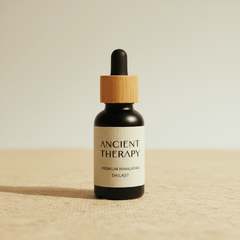



Comparative Shilajit Guide • Pure • Lab-tested • Certified Organic
Short version:
- Drops — precise pipette dosing, fast-mixing liquid, neutral taste and very clear quality signals. Ideal for daily rituals and travel.
- Resin — traditional feel and “old school” experience, but sticky, slower to mix and harder to dose consistently.
- Capsules — pre-measured and taste-neutral, but quality depends entirely on the raw material and what else is in the capsule.
- Non-negotiable: always look for third-party lab testing, heavy-metal screening and batch COAs you can view before you buy.
Shilajit Drops vs Resin vs Capsules: Which Form Fits Your Ritual?
What are the main forms of Shilajit?
Shilajit is a natural mineral resin – not an herb. Once it’s harvested and purified, brands usually offer it in three formats: liquid drops, traditional resin (paste) and capsules.
The form you choose shapes your experience: how easy it is to dose, how clean your routine feels and how transparent the quality is. If you’re new to Shilajit, it can help to start with the basics in What Is Shilajit? and then explore the deeper science in Shilajit & Fulvic Acid.
How do drops, resin and capsules compare?
Below is a quick side-by-side of how each form works in real life — from dosing and taste to transparency and testing.
| Property | Drops (pipette) | Resin (paste) | Capsules |
|---|---|---|---|
| How you use it | Add drops to warm water, tea or coffee | Scrape a pea-size amount and dissolve in warm water | Swallow capsules with water |
| Dosing control | Precise pipette — start 4–6 drops; typical 6–10 per day | Manual “eyeballing” — harder to repeat the exact same amount | Fixed per capsule — easy but less flexible |
| Convenience | Very fast, travel-friendly, no mess | Sticky, slower to mix, less practical on the go | Very easy — just swallow |
| Taste & feel | Neutral to mild; disappears easily in drinks | Strong, earthy taste; more “old-school” feel | Taste-neutral (you only taste the capsule shell, if anything) |
| Label & additives | Often very short ingredient list if done well | Usually just resin, but quality varies by supplier | Check for fillers, flow agents and blends |
| Quality / COA visibility | Clear opportunity to show COA & third-party testing for each batch | Depends on supplier — you must ask for COA and origin | Depends on raw material, capsule shell and published COA |
Which form fits your daily ritual?
Choosing a form is less about “right vs wrong” and more about how you like to live, work and wind down. Here’s a simple way to decide:
- For structured biohackers: Drops make it easy to fine-tune the number of drops, stack with other supplements and track your intake.
- For women in wellness: Drops blend smoothly into tea, warm water or a morning tonic — no strong taste, no mess.
- For frequent travellers: Drops or capsules are easiest in airports, offices and hotels. Resin tends to be less practical on the go.
- For traditionalists: Resin offers the most “hands-on” ritual if you enjoy the act of dissolving and stirring your serving.
- For minimalists: Look for the format with the shortest ingredient list and the clearest testing information.
Core idea: pick the form you will actually use every day — consistency beats perfection.
How do you use Shilajit drops? (simple routines & dosage)
Example routines — not medical advice. Always listen to your own body.
- Morning focus ritual: Add ~4 drops to a glass of warm water before coffee. Take 5–10 slow breaths and set a simple intention for the day.
- Pre-workout steadiness: Use ~5 drops 20–30 minutes before training for a more stable feel compared to classic stimulants.
- Evening wind-down: Try 3–4 drops in herbal tea to mark the transition from “doing” to “resting”.
- Dosage guide: Start with 4–6 drops once daily. Typical range is 6–10 drops/day. Upper practical level is around ~20 drops/day, split into 2–3 servings if desired.
Keep a 2–3 hour gap from prescription medications and large single doses of iron or zinc.
For a broader overview of how Shilajit fits into energy and recovery, explore Natural Energy Boosters and Adaptogens & Stress.
How to check if your Shilajit is pure (quality & testing)
Regardless of form, quality and testing are non-negotiable. We recommend Shilajit that is: Certified Organic, small-batch and third-party lab-tested with open COAs.
- Heavy metals: look for ICP-MS testing for lead, arsenic, cadmium and mercury.
- Microbiology: testing for unwanted bacteria, yeast and mould.
- Identity & fulvic acid: verification that it is real Shilajit with a defined fulvic-acid content.
- Batch ID: every product should be traceable back to a specific batch report.
COA & lab testing — heavy metals, microbiology and fulvic percentage are verified for every batch.
- Current batch example: View COA (PDF)

FAQ — drops vs resin vs capsules
Are Shilajit drops as “pure” as resin?
Purity depends on the raw material and purification — not the format. Both drops and resin can be very pure or very poor. Always check the COA and third-party testing.
How do I dose Shilajit drops?
Use the pipette and start with 4–6 drops once per day in a warm drink. If you feel good, you can slowly move towards a typical range of 6–10 drops/day, up to ~20 drops/day split into 2–3 servings.
Do drops taste different from resin?
Yes. Drops are usually much more neutral and disappear easily in water, tea or coffee. Resin has a distinct, earthy taste and a thicker texture.
What does “Certified Organic & lab-tested” actually mean?
Organic refers to how the product is handled and produced. Lab-tested means an independent laboratory checks every batch for heavy metals, microbiology and identity markers, documented in a COA.
Are capsules simpler than drops?
Capsules are convenient and taste-neutral, but you have less flexibility with dosing and need to read the ingredient list carefully. Look out for fillers and always ask for the COA for the content.
Can I switch between forms without changing my ritual?
Yes. If you change from resin or capsules to drops (or vice versa), start low with the new form for 3–5 days and see how you feel before adjusting upwards.
Where can I learn more about Shilajit itself?
Start with What Is Shilajit? and Shilajit & Fulvic Acid for a deeper technical overview.
Related guides
- What Is Shilajit? — understand the Himalayan mineral resin.
- Shilajit & Fulvic Acid — the key compound and why it matters.
- How Shilajit Works in the Body — mechanisms and practical takeaways.
- Buying Shilajit Online — 5 things to check before you add to cart.
Ready to choose your form?
If you want precise dosing, a clean taste and open COAs, Shilajit drops are often the easiest place to start. One bottle can follow you from quiet mornings at home to busy days and late-night flights.
Pure • Lab-tested • Certified Organic • Everyday balance
Prefer to compare all options? See all energy formats.
Science & references
Shilajit is a natural complex rather than a single isolated molecule, so most evidence comes from mechanistic studies, safety evaluations and a few human trials. Key open-access papers include:
- Fulvic acid – therapeutic potential (review). Overview of fulvic acid chemistry, redox activity and proposed biological roles (PMC6151376).
- Shilajit – composition & clinical evidence (review). Summarises traditional use, mineral content and early human data on performance and recovery (PMC3296184).
- Humic & fulvic acids – toxicological safety evaluation. Modern review focused on safety, contaminants and dose considerations (PMC7505752).
- Shilajit supplementation & fatigue-resistant strength (8-week trial). Human study exploring mitochondrial support, exercise performance and perceived fatigue (PMC6364418).
This list is not exhaustive, but highlights core open-access sources we use when formulating and communicating about Shilajit. Natural products vary; always combine research with your own experience and professional guidance.
Quality owner: Ancient Therapy Quality Team — small-batch production, batch traceability and open COAs. Contact: info@ancienttherapy.com
Editorial note: Informational only. Not medical advice.
Leave a comment